partner compliance
Finfluencer Compliance: What Banks and Fintechs Need to Know (2026)
A finfluencer is a social media creator who promotes financial products or shares investment content. When a creator promotes your product on your behalf, that content can qualify as a financial promotion in the UK or a regulated marketing communication in the EU: the firm remains responsible for it, and the creator can have obligations of their own. Compliant programs treat creators like any other marketing partner: clear guidelines, approval before publishing, and continuous monitoring of what actually goes live.
Part of: Partner Compliance guide →
Why finfluencers became a compliance topic
Financial influencers, creators who talk about money, trading and financial products to large audiences, have become a mainstream acquisition channel. For a fintech, a well-chosen creator can explain a product better than any banner ad. For a compliance team, the same creator is a marketing partner who publishes fast, improvises, and works in formats that were never designed with risk warnings in mind.
Regulators noticed early. The FCA has issued dedicated guidance on financial promotions on social media, making clear that the rules are technology-neutral: a promotion is a promotion whether it appears in a newspaper or in a fifteen-second video. It has also taken enforcement action against individual influencers who promoted high-risk products unlawfully. In the EU, ESMA and national regulators, including CONSOB in Italy, have repeatedly warned about investment recommendations and product promotion on social media, and MiCA extends the familiar duties to crypto-asset marketing.
The core principle: the rules follow the product
The legal detail differs by market, but the operating principle is consistent across the UK and EU:
- Content that promotes a financial product can qualify as a financial promotion (UK) or a regulated marketing communication (EU), whatever the format and whoever posts it.
- The firm behind the product is accountable for promotions made on its behalf. Paying a creator does not transfer the responsibility; in most cases it creates it.
- Promotions must be fair, clear and not misleading, with balanced presentation of risk and any required warnings, in the content itself, not buried in a bio link.
This is why “we told the creator what to say” is not a defence. What matters is what actually went live, on which channel, and for how long. Independent, unpaid commentary is a different matter: responsibility turns on the commercial relationship and the firm’s involvement, not on the mere mention of a product.
Where creator programs go wrong
Across the programs we see, the failure patterns repeat:
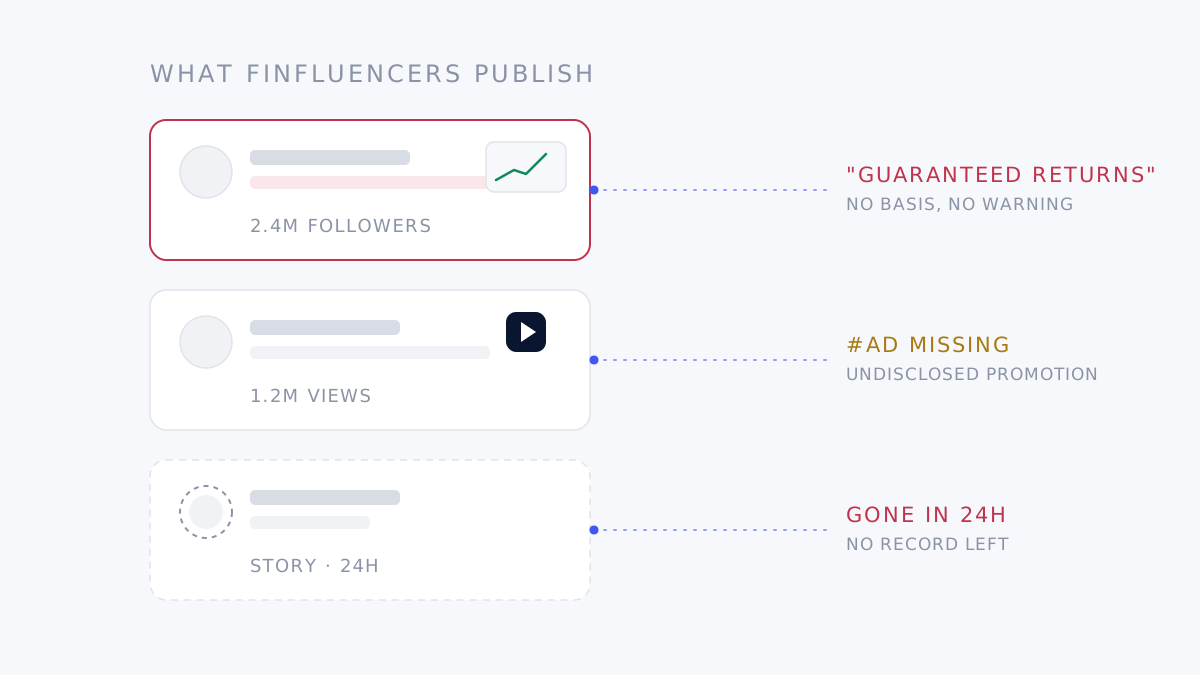
- The approved script drifts. The creator got an approved brief, then improvised in the caption, the Story or the follow-up video. The approved version exists in an email thread; the published version exists in front of the audience.
- Risk warnings get cropped. A warning that survived the main video disappears in the fifteen-second cut, the repost or the Story.
- Disclosure is treated as compliance. #ad answers the advertising rules, not the financial promotion rules. A labelled post can still overpromise returns or omit required information.
- Ephemeral formats escape review. Stories and live streams are gone in a day. Without capture, there is no record of what was said, which is a problem both for detection and for the audit trail.
- The network is wider than the contract list. Sub-creators, clip accounts and fan pages republish product content the firm never saw, sometimes with the firm’s tracking links attached.
What a compliant program looks like
Treat creators like any other marketing partner, with the same lifecycle you would apply to affiliates:
- Onboarding and guidelines. Written rules per product and per market: what can be claimed, which warnings are required, what is off-limits.
- Approval before publishing. Review the actual asset, not just the concept, and record the approval.
- Continuous monitoring of what is live. Check published content against guidelines, including edits, cut-downs and reposts, not just the originally approved asset.
- Evidence and resolution. When something is off, have a route to correction or takedown, and keep a time-stamped record of the finding and the fix.
The first two steps are process. The last two are where manual approaches break down, because creators publish continuously and the content changes after approval. This is the part BIQUO automates: monitoring creator and partner content across channels, classifying it against your guidelines in real time, and keeping the audit trail that shows a regulator your oversight is ongoing, not occasional.
The bottom line
Finfluencer marketing is not going away, and regulators are not asking firms to avoid it. They are asking firms to control it with the same rigour as any other promotion channel. The firms that get this right treat paid and commissioned creator content as what it can legally be, a promotion made on their behalf, and put the monitoring in place to prove it.
Frequently asked questions
Is an influencer post really a financial promotion?
If it invites or induces someone to engage in investment activity or to take a financial product, yes. The format does not matter: a TikTok video, an Instagram Story or a swipe-up link can all qualify, and the same rules on being fair, clear and not misleading apply.
Who is liable if a creator breaks the rules, the creator or the firm?
Both can be. The creator may be communicating an unlawful promotion, and the firm whose product is promoted is accountable for promotions made on its behalf. Regulators have pursued firms and individual influencers.
Do disclosure hashtags like #ad make a post compliant?
Disclosure is necessary but not sufficient. The post must also present the product fairly, include required risk warnings, and avoid misleading claims. A properly labelled advert can still be a non-compliant promotion.
How do firms monitor creator content in practice?
Manually reviewing feeds does not scale past a handful of creators, and content changes after approval. Firms increasingly use automated monitoring that checks creator content continuously against guidelines and keeps evidence of what was live and when.