partner compliance
The Partner Compliance Checklist for Banks and Fintechs (2026)
A partner compliance program stands on six controls: a complete partner register, written guidelines per product and market, approval before publishing, continuous monitoring of what is actually live, a tracked resolution path, and a time-stamped audit trail. If any of the six is missing, the gap usually surfaces in a regulator's questions before it surfaces in your reports.
Part of: Partner Compliance guide →
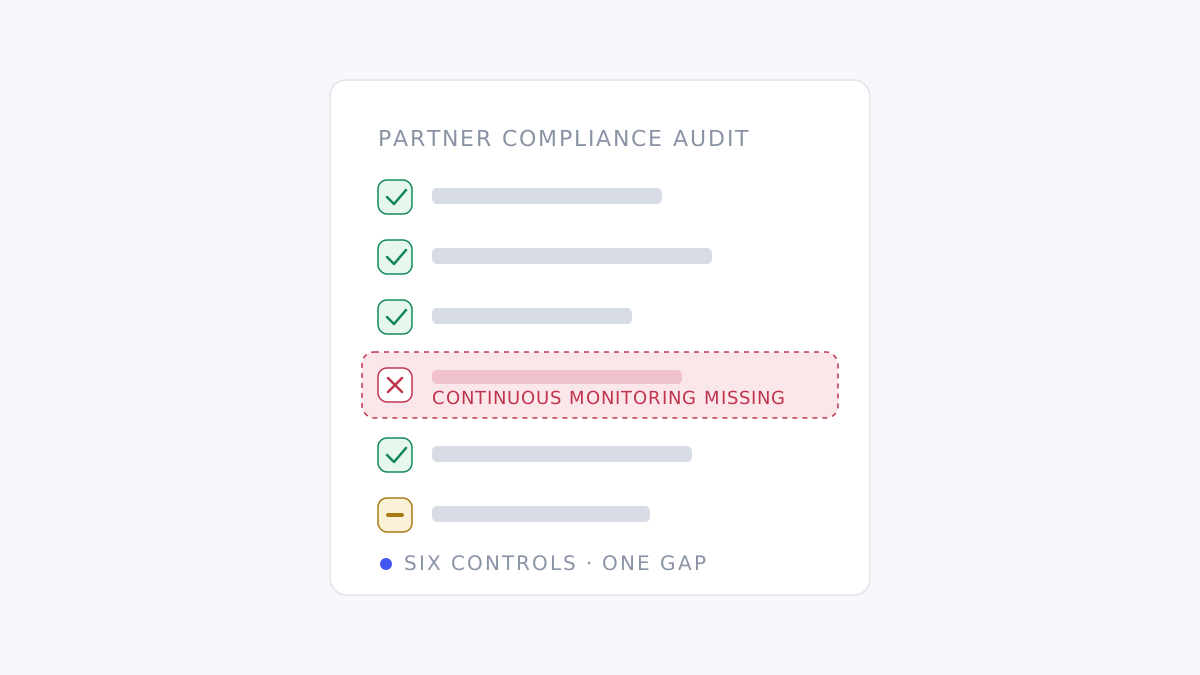
Every partner compliance program we see, large or small, stands or falls on the same six controls. Use this page as an audit of your own setup: each section is a check, and the questions under it tell you whether you would pass it.
1. A complete partner register
You cannot oversee a network you have not mapped.
- Is there a single register of every partner marketing your products: affiliates, comparison sites, creators, introducers?
- Does it record each partner’s domains, channels and the products they promote?
- Is it updated when partners add sites or sub-partners, not just at renewal?
- Would you detect a site using your tracking links without being in the register?
The last question is the one most programs fail. The truly active network is usually wider than the contracted one, and the difference is invisible until something monitors for it.
2. Written guidelines, per product and per market
Rules that live in people’s heads cannot be enforced or evidenced.
- Do partners receive written guidelines for each product and market: required disclosures, risk warnings, prohibited claims, brand usage?
- Are they updated when an offer or a regulation changes, with a record of which version was in force when?
- Does anything re-check previously published content against the new version?
That last point matters because published content does not stay compliant. A page that was accurate at launch quietly drifts out of date the day the offer changes.
3. Approval before publishing
- Is the actual asset reviewed, not just the concept or the brief?
- Is the approval recorded, with the version that was approved?
- Do ephemeral formats, Stories and live streams, have a defined approval path?
4. Continuous monitoring of what is live
Approval covers the moment of publishing. Everything after that is monitoring.
- Is every registered partner’s content checked on an ongoing basis, not sampled quarterly?
- Are edits, cut-downs and reposts caught, or only the originally approved asset?
- Are short-lived formats reviewed before they expire?
- Does coverage extend beyond the register, to sites and accounts using your links without being declared?
This is the control where manual approaches break first, because partners publish continuously and review capacity does not scale with them. The comparison is covered in detail in manual vs automated monitoring.
5. A tracked resolution path
A finding without an owner is a finding that stays live.
- Does every flag have an owner, a severity and a deadline?
- Is there an escalation path for partners who do not fix things?
- Is closure verified against the live content, not just promised over email?
6. A time-stamped audit trail
The regulator’s question is rarely “did this violation happen”. It is “show me how you oversee this”.
- Can you produce, for any period, what was monitored, what was found and how it was resolved?
- Is the record time-stamped and complete, rather than reconstructed from inboxes?
- Would it survive the departure of the person who currently maintains it?
Scoring yourself
Six controls, each with a short set of assessment questions: treat every “no” as a gap with a name. Most firms pass onboarding and guidelines, wobble on approval, and fail on monitoring, resolution tracking and evidence, because those three only work at partner scale with automation. That is the part BIQUO takes over: continuous monitoring against your guidelines, a tracked lifecycle for every finding, and an audit trail that is built as a by-product of the work rather than assembled for the inspection.
Frequently asked questions
Where should a firm start if none of this exists yet?
Start with the register and the guidelines. You cannot monitor a network you have not mapped, and you cannot flag content without rules to flag it against. The other controls build on those two.
How often should the partner register be reviewed?
Continuously, not annually. Partners add pages and sub-partners between reviews, and sites outside the register may be using your tracking links. Monitoring should feed the register, not the other way around.
What evidence do regulators actually ask for?
Proof of ongoing oversight: what was checked, when, what was found, and how it was resolved. Point-in-time screenshots and email threads are weak evidence; a time-stamped record of monitoring and resolution is strong evidence.