The guide · 2026
Partner compliance for banks & fintechs
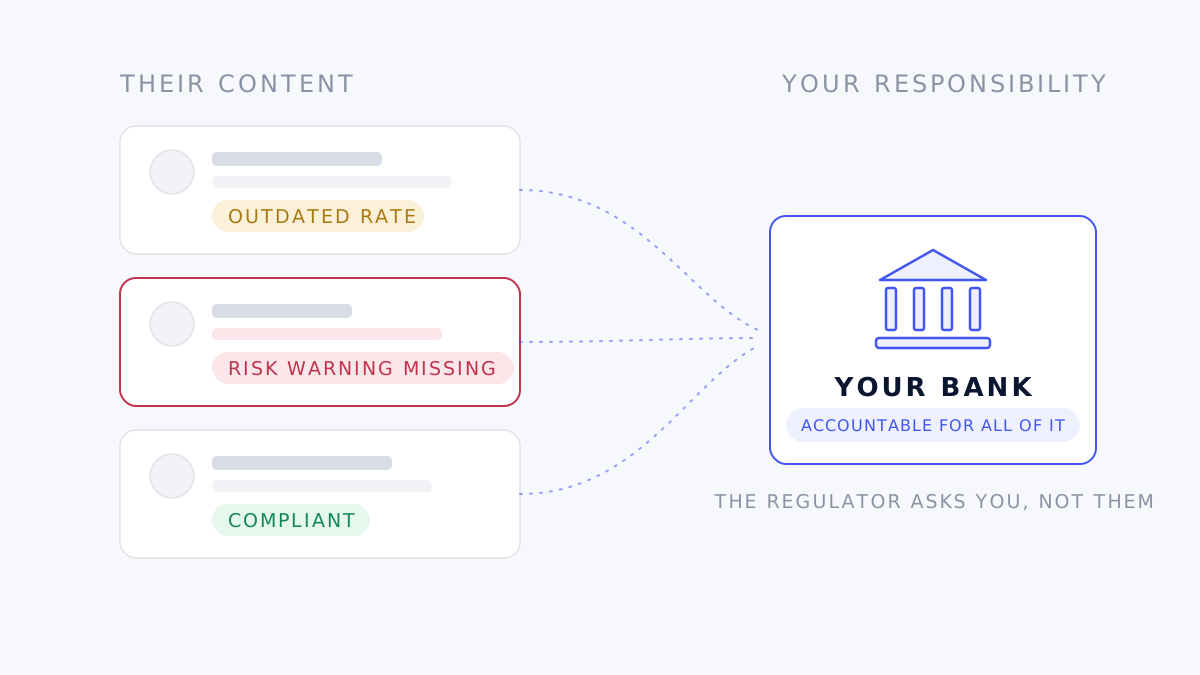
When an affiliate oversells a loan or a finfluencer skips the risk warning, the regulator doesn't stop at the partner. It comes to you too. Here is how to keep your partners' marketing inside the rules, across the UK and EU.
What partner compliance actually means
Partner compliance means making sure the marketing your third parties publish on your behalf is accurate and properly disclosed. Banks say partner compliance. Affiliate networks say affiliate compliance. Regulators just say financial promotion, and they hold whoever’s product is being sold responsible for it. One duty, three names.
So whether the content comes from a comparison site, a finfluencer on TikTok, or an introducer’s landing page, the question is the same: does it say something about your product that you’d be comfortable defending to the FCA?
Why it still lands on you
Under the UK’s financial promotion regime (section 21 of FSMA 2000) and the EU’s MiFID II and MiCA rules, you remain accountable for promotions made on your behalf, even when someone else hits publish. The publisher can face action of its own, but that does not remove your obligations. An affiliate’s “best account of 2026” claim or a creator’s undisclosed paid post can become your breach, your fine, and your headline.
The hard part is pace. Partners publish constantly, on channels and in formats that a quarterly spreadsheet review was never built to catch. A video goes up, a customer clicks, and the problem is live long before anyone in compliance has seen it.
The partners who put you at risk
Affiliates and comparison sites. Publishers that rank your products and take a cut when someone signs up. The oldest channel, and still the noisiest.
Finfluencers and creators. The fastest-growing risk, and the one the FCA and ESMA are watching hardest right now.
Introducers and lead-gen partners. Networks that send you customers and write their own pitch on the way in.
The rules, market by market
The core duty barely changes across borders: marketing has to be fair, clear and obviously marketing. Who enforces it, and how closely they read social media, is what differs.
| Market | Regulator | What it asks for |
|---|---|---|
| United Kingdom | FCA | The financial promotion regime under s21 FSMA 2000. Every promotion must be fair, clear and not misleading, with specific guidance for social media and finfluencers. |
| European Union | ESMA, MiFID II, MiCA | Marketing must be clearly identifiable as marketing and never misleading. MiCA carries the same duty into crypto-asset promotion. |
| Italy | CONSOB, Banca d’Italia | Supervise how financial products are promoted and sold, online and through influencers included. |
| Malta | MFSA | Conduct-of-business and financial-promotion supervision, social media and influencers included. |
Treat this as orientation, not advice. Check the current text with your compliance team.
How to keep up without a spreadsheet
By the time a person opens the monitoring sheet, the post is live and the customer has clicked. The only thing that keeps pace is a continuous loop: watch every partner, judge each piece against the right rules, fix what breaks, and keep the receipts.
- 01
Detection. Watch partner content across the web and social channels, continuously.
- 02
Triage. Classify each piece as compliant, warning or violation as it lands.
- 03
Investigation. Add the regulatory context and decide how serious it is.
- 04
Resolution. Send it to whoever owns the fix and track it to closure.
- 05
Audit. Keep the time-stamped record for the day a regulator asks.
Most teams start by weighing up manual versus automated monitoring. The maths stops being close once you pass a handful of partners.
Read the rest of the guide
Get it done
- Manual vs automated monitoring
- Partner compliance checklist
- Run a partner compliance audit
By partner type
- Affiliate compliance
- Finfluencer compliance
- Introducer compliance
- Common violations
By market
- UK: FCA promotions
- EU: MiCA & ESMA
- Italy: CONSOB
- Malta: MFSA
Questions we get asked
What is partner compliance?
Partner compliance means making sure the marketing your third parties publish on your behalf is accurate and properly disclosed. Banks say partner compliance, affiliate networks say affiliate compliance; UK rules speak of financial promotions and EU frameworks of marketing communications. Terminology and detail vary by product and jurisdiction, but the underlying duty recurs: marketing must be fair, clear and not misleading, whoever publishes it.
Why are banks responsible for what their partners publish?
Because the rules put the firm whose product is sold on the hook. Under the UK financial promotion regime and EU frameworks such as MiFID II and MiCA, you remain accountable for promotions made on your behalf even when a partner is the one who hits publish. The partner can have obligations of its own, but they do not replace yours.
Is partner compliance the same as affiliate compliance?
Affiliate compliance is one slice of it. Partner is the word banks use for every outside party that markets for them: affiliates, comparison sites, finfluencers and introducers. Affiliate compliance is specifically about commission-based publishers.
Which rules apply across the EU and UK?
The core duty is the same everywhere: marketing must be fair, clear and not misleading. The FCA enforces it in the UK, ESMA under MiFID II and MiCA in the EU, CONSOB and Banca d’Italia in Italy, and the MFSA in Malta.
How do you monitor it at scale?
Not by hand. Partners publish faster than any spreadsheet review can keep up. Automated monitoring watches every partner, classifies each piece against the right rules in real time, and keeps the audit trail. That is what BIQUO is built to do.
See it run against your own partners.